

During the Trail of Tears in America, more than 13,000 Native Americans were killed. Due to American colonization it’s estimated that Native American populations decreased by 90-95%. That’s approximately 45-55 million people. Australian colonization? Over 2 million dead, a decrease of population by 93%. Even more across Europe, New Zealand, Canada, Africa.
The world participated.
Six million Jewish people were killed by Nazi Germany within just a 4 year period between 1941 and 1945. Six. Million.
The world watched.
The ongoing genocide of the Palestinian people, which has been happening since 1948, has killed more than 130,000 people. More than 75,000 of those people have been killed just since 2023.
The world continues to watch.
If those numbers don’t make your skin crawl, your stomach churn, and your heart ache then I don’t know what else to say. There is nothing that can ever justify those numbers. There is nothing we can do to bring those people back. There is never a reason for such wide scale violence.
And yet it persists. Day in and day out wars are fought with your money. Yes, yours. Every purchase from Microsoft goes to helping kill more Palestinians. Each purchase from NVIDIA is another possible dollar for the IDF. Every dollar to Epic Games (including Unity) is money used to train soldiers in murder. And these are just companies within gaming, don’t even get me started on other major companies doing the same thing.

For decades, centuries we’ve been doing the same disgusting song and dance. We take everything, we rape the Earth, and then we look around for our next victim. Oftentimes we look around for someone that looks slightly different from us and we take it out on them.
“Because we’re better than them!”
“Because we’re smarter than them!”
“Because we deserve it!”
Any justification we can pull from our asses to quell the smallest inkling of wrong-doing. H.P. Lovecraft was one such man that made many such justifications for his vile views. While many modern interpretations of Lovecraft’s works like to shy away from who he was as a person and what he thought of others, Penguin Colony is a different and very refreshing story.
Finally to the point, Penguin Colony is a re-imagining of the classic Lovecraft story, At the Mountains of Madness. Set during the events of World War II, Penguin Colony is a cosmic horror game told from the perspective of a penguin (mostly). Narrated by Lenval Brown, most notorious for his work in the 2019 hit Disco Elysium, a story will unfold alongside you as you waddle your way through the Nazi party’s camps and descent into madness. Simply plopped into the vast terrain of Antarctica, you are given only gentle guidance on where to go before allowed free reign to explore. With audio logs, photos, memories, and settlements to discover there is no shortage of things to go looking for out in the snowy wasteland and, for the most part, it is a joy to explore.
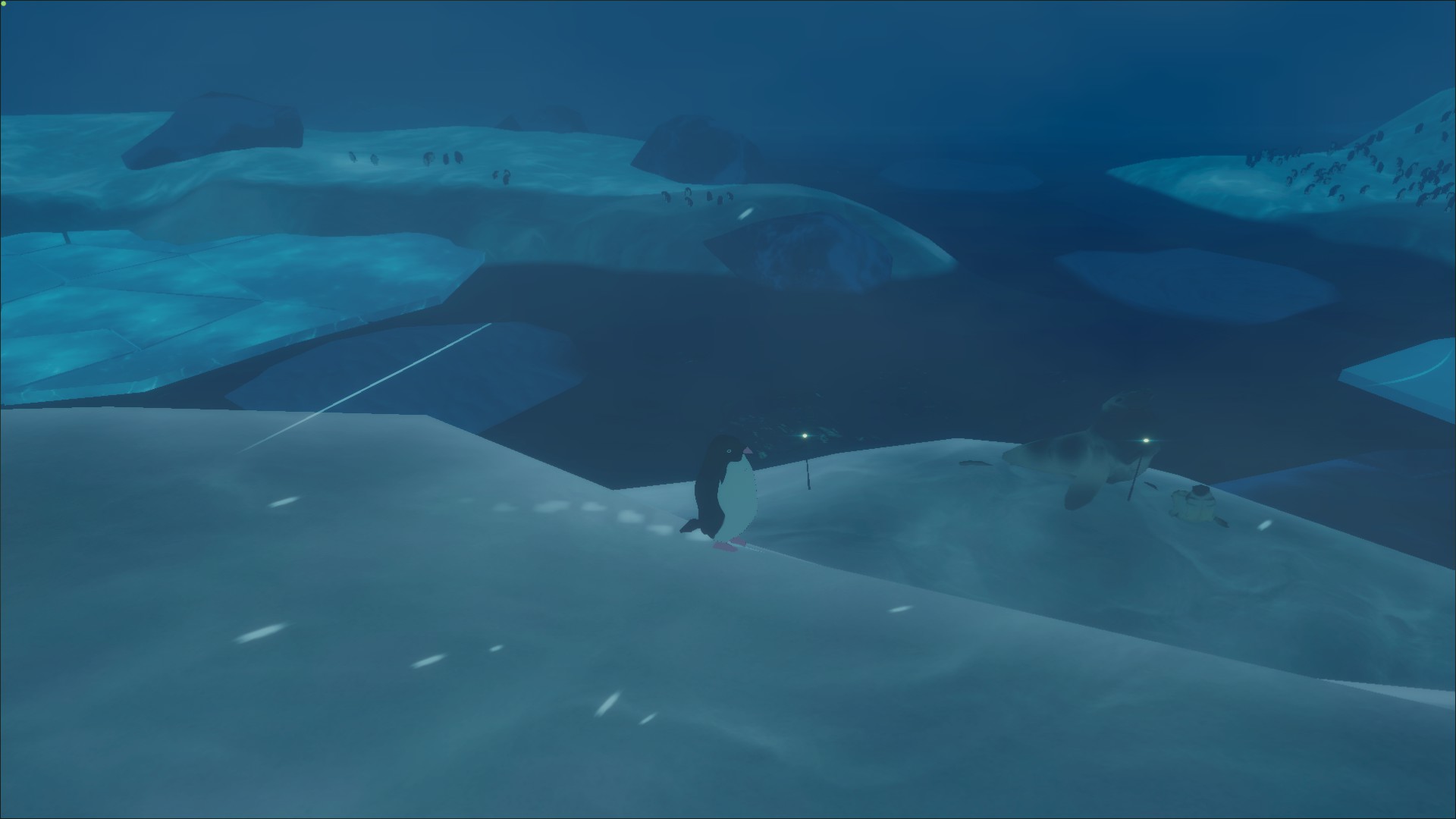
In Penguin Colony you don’t just play as one penguin, you play as all of them. With the ability to swap bodies if you’re close enough, you’ll find yourself swapping between penguins frequently for a variety of reasons. There are multiple penguins in Penguin Colony, each with distinct characteristics that make playing as them advantageous depending on the situation you’re in. Sometimes you'll need a penguin with a lot of stamina to make it up a hill. Sometimes you’ll need a baby penguin to fit into a small space. Sometimes you’ll need to be a large penguin to interact with specific objects. Some penguins even have unique skills like photography or special calls, making them that much more engaging to play as.
There was a real incentive to switch penguins and I was always keeping track of what type of penguins were nearby in case I needed one for a puzzle. Each penguin even has a fact sheet in the pause menu to show you their height and tell you some information about them, which I found not only endearing but also highly useful for gameplay.
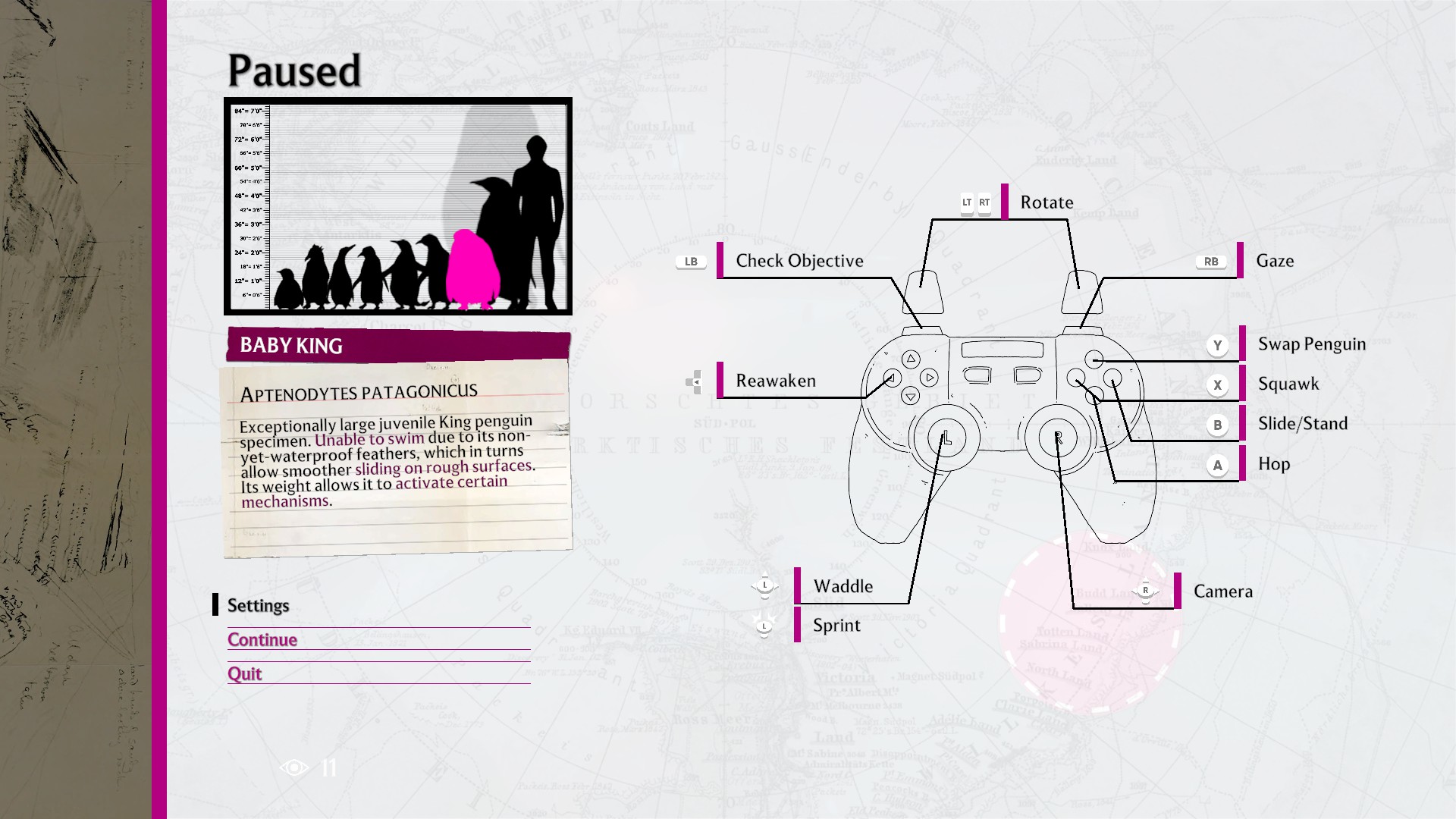
In the pause menu there's a penguin fact sheet, which updates information and highlighted picture depending on what species you currently are.
From here the loop is relatively simple: waddle, jump, swim, and belly-slide your way across the snowy landscape while picking up breadcrumbs that tell an all-too-common story of colonization, white-supremacy, and greed. (Note: When I say “all-too-common story”, I mean in real life. The themes within Penguin Colony are, as far as I’m concerned, not told enough in media; especially in such a genuine and raw way like they are here.) As you journey across the land there will be moments of human gameplay interspliced between acts, telling the story of the fictional natives that live in Antarctica and protect the land from any danger; Lovecraftian or not. Across the land itself you will come across camps, bodies, and the otherworldly.
While I really did enjoy this story, which I will mostly leave for you to discover through your own journey across Antarctica, the gameplay left much to be desired. Initially I quite liked my time with Penguin Colony as far as gameplay goes, but as time went on my patience wore thin. Very thin.
At the beginning of the game the layout of the map was mostly barren, snowy lands you could easily belly-slide across, do tricks on, and make good progress with; which all felt extremely satisfying to do. Of course, throughout your journey you will be asked to interface with human construction, which does take a lot more time to use as your waddle is much more tedious than your sliding, but I found the balance enjoyable. As you progress further into the Lovecraftian structure taking over the land the balance in gameplay shifts, and not in a way I found enjoyable. I found myself needing to platform much more frequently than I found myself able to slide around, which was not only tedious, as I mentioned, but also extremely inconsistent and janky.
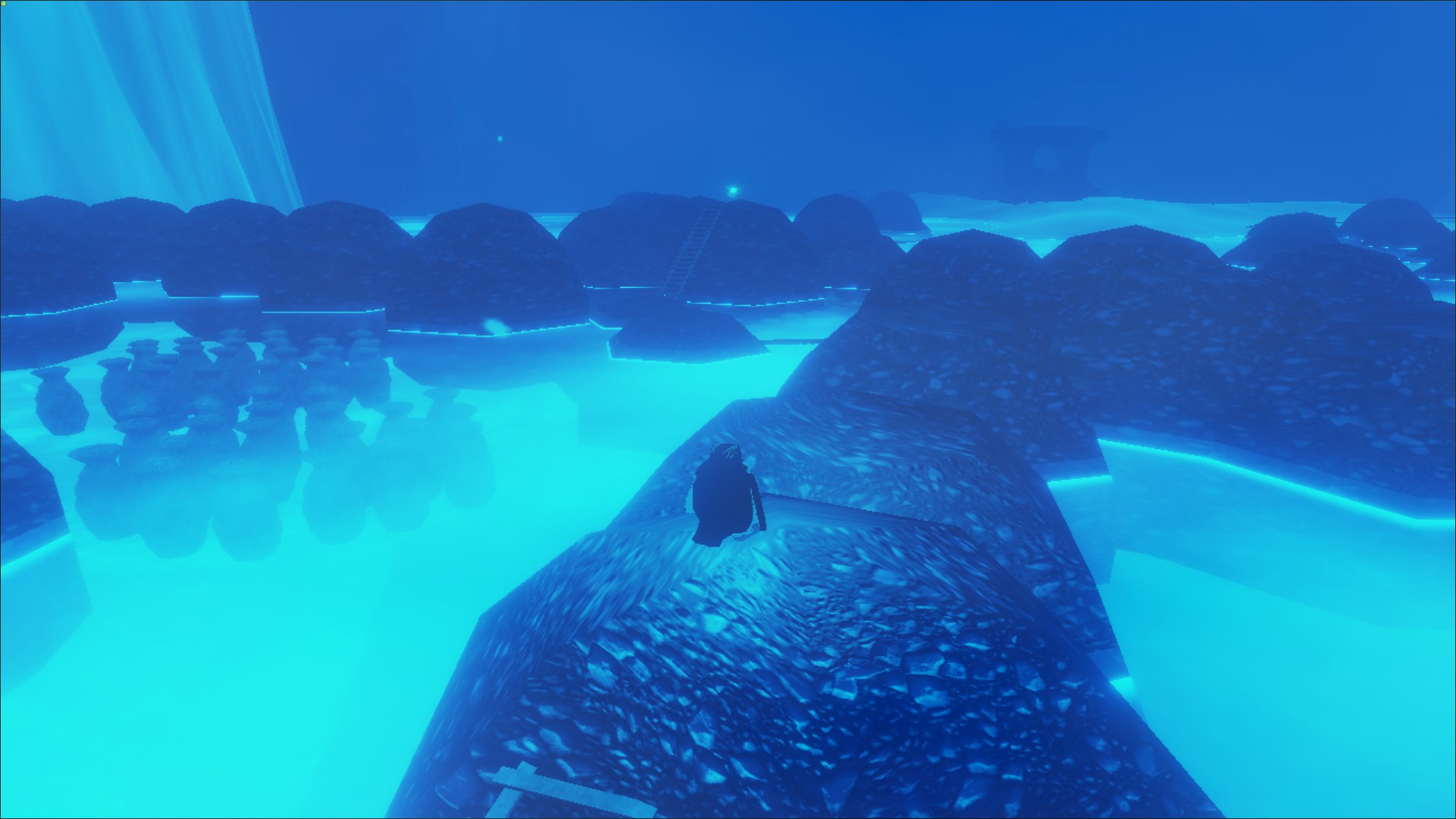
A collectable sits atop a rock in a sea of deadly water and similarly shaped rocks, which you must slowly waddle and jump across to pick up. Fall in the water? Die and start again.
Furthermore, the map design in these later areas felt unintentional and, at worst, mean-spirited. Small holes in the geometry that perfectly allowed my penguin to fall to the floor, losing all platforming progress and sometimes even getting me stuck in a 1x1 box. Staircases leading to absolutely nothing. Water that will kill you if you swim in it, but also a collectible in the middle of said water. Bridge after bridge with large holes in them so you couldn’t just slide across, you had to slowly waddle and jump the gap. Stairs you had to hammer the jump button to climb up riddling the map.
Decision after decision that ensured the gameplay was more tedious than fun; and while I enjoy some friction in my games I simply did not enjoy a large portion of the ending in terms of gameplay. Which is beyond sad, as I said I think the belly-slide mechanic is done phenomenally well, even if it is extremely floaty, and I would have loved it if more of the game made space for that mechanic.
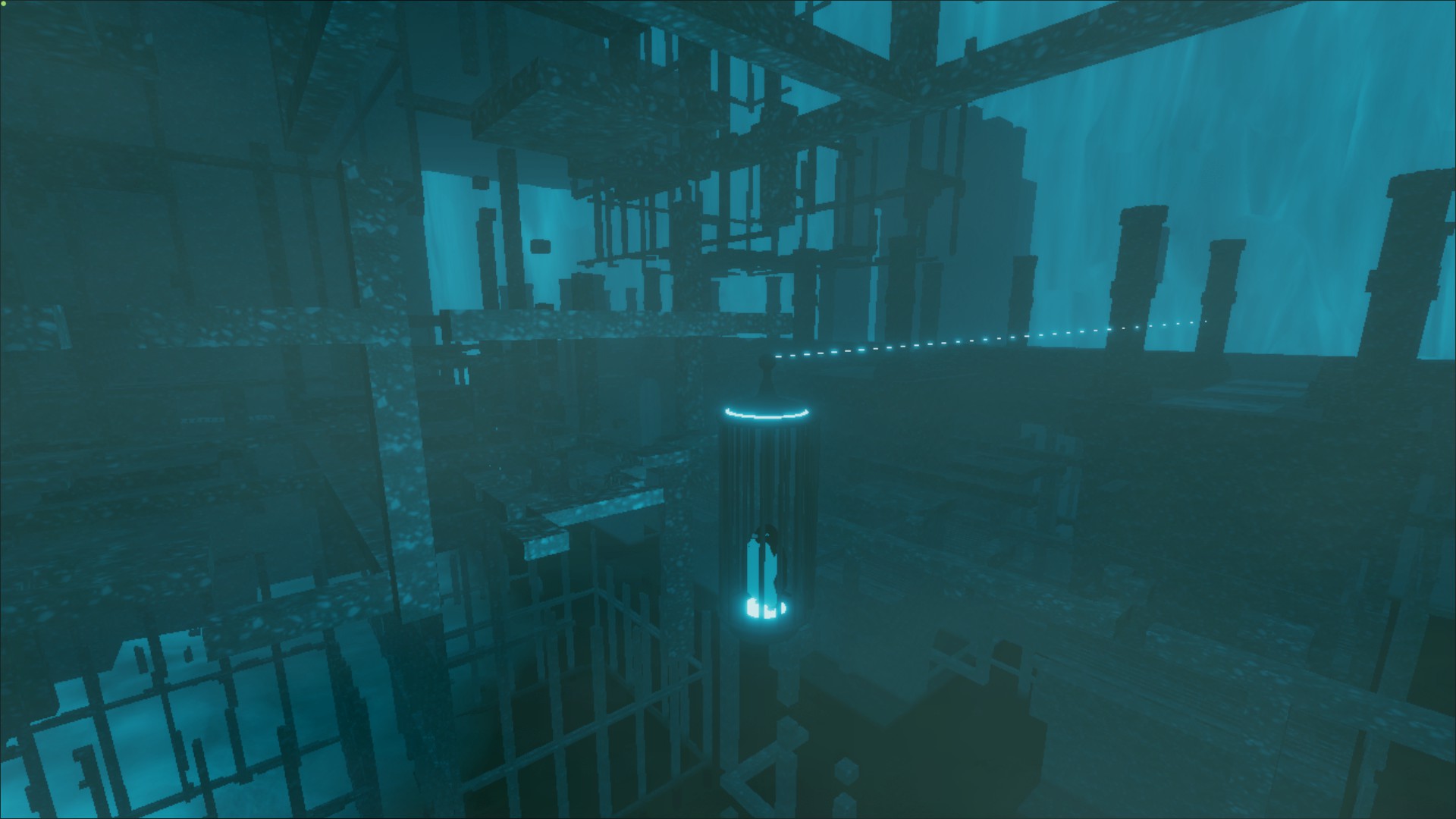
The 'Anor Londo' of Lovecraftian penguin games.
In addition to my complaints about gameplay, I found the human segments to be extremely under-baked. While I adored what they did for the theatrics of the experience, from a gameplay perspective I found them disappointing. Often just a segment where you hold a direction on the stick and watch as the scene plays out, there was a segment that teased an entire boss fight; with combat mechanics, a dodge roll, and even enemy and ally health bars. That turns out to be a fake-out and, as soon as you approach the boss, the screen goes white and you’re returned to the body of a penguin.
Why?
Why design the boss, the health bars, the animations for all the combat just to snatch it away from me a moment before I engage? Did the developers assume this would be a cool moment for the player? It was not.
And this isn’t to say I need combat in my games to be engaged. I play a lot of games that lack combat and I’m perfectly happy to play what some might call a “walking sim” or, simply, a narrative-driven game. But giving the player a glimmer of gameplay only to steal it away ended up leaving me annoyed and dissatisfied. There’s even, what I would call, an important character moment during the fight that is completely off-screened and is left up to player interpretation; which I don’t think helps in that feeling of dissatisfaction.
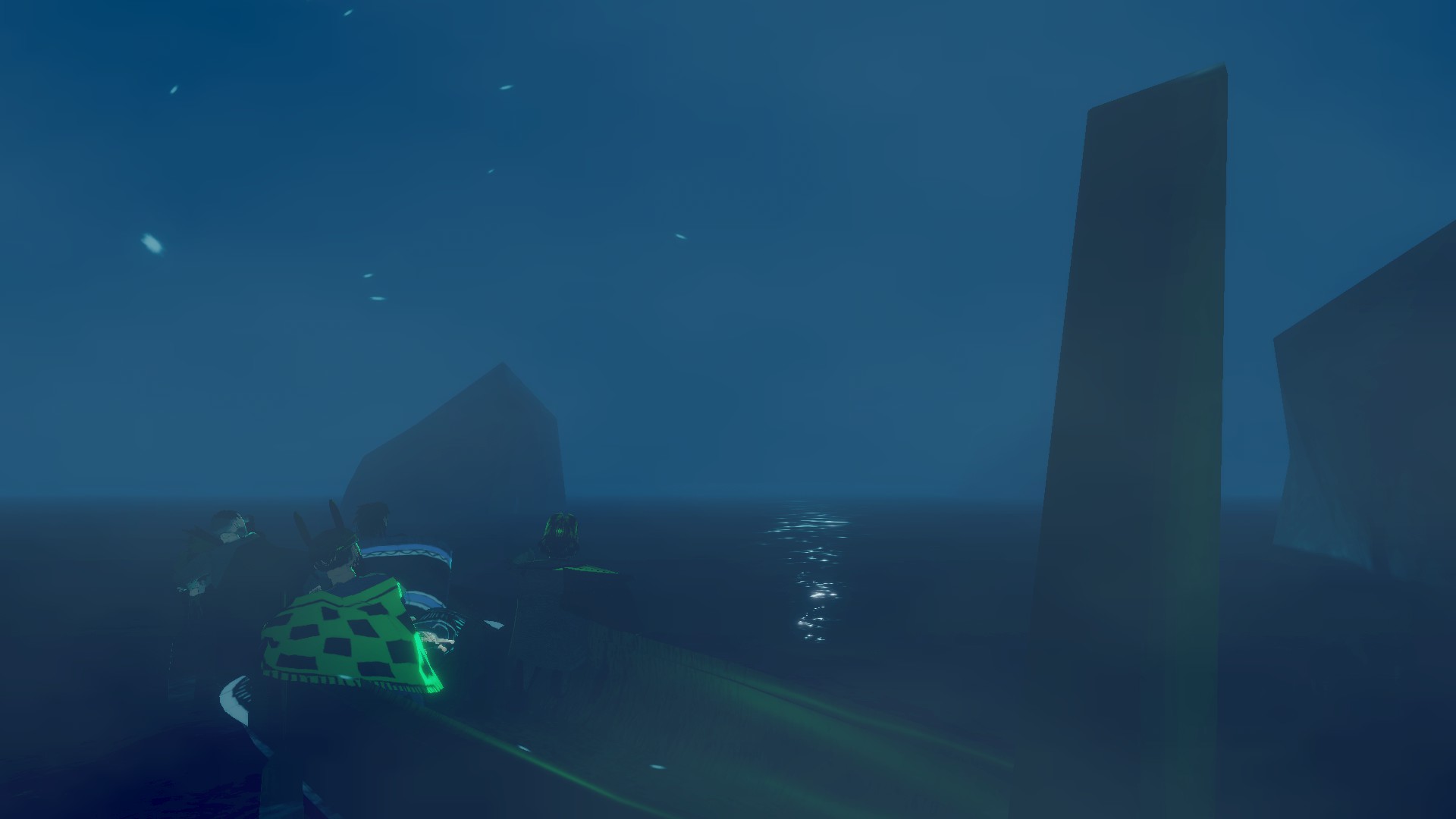
A small group of natives take a boat toward a destination - we are privy to rowing the boat for a small moment before returning to our penguin body and continuing forward.
I unfortunately also had a number of crashes during my time playing the game, which will hopefully be patched by its release today, but that didn’t help and only bolstered my issues with gameplay given the autosaves are infrequent and would often set me back dozens of minutes of progress. The intended level of tedium became much more than I wanted to handle when I had to restart multiple times, which also led to me getting lost more than once due to not remembering what I did and did not do.
With all of that said, I adored the story and writing of Penguin Colony. I found the themes to not only be relevant now, but wholly relevant to us as a people across all our history. There’s a lot going on here in regards to racism, the desire to amass copious amounts of wealth and power, how that desire can corrupt and twist men into monsters, and, of course, colonialism.
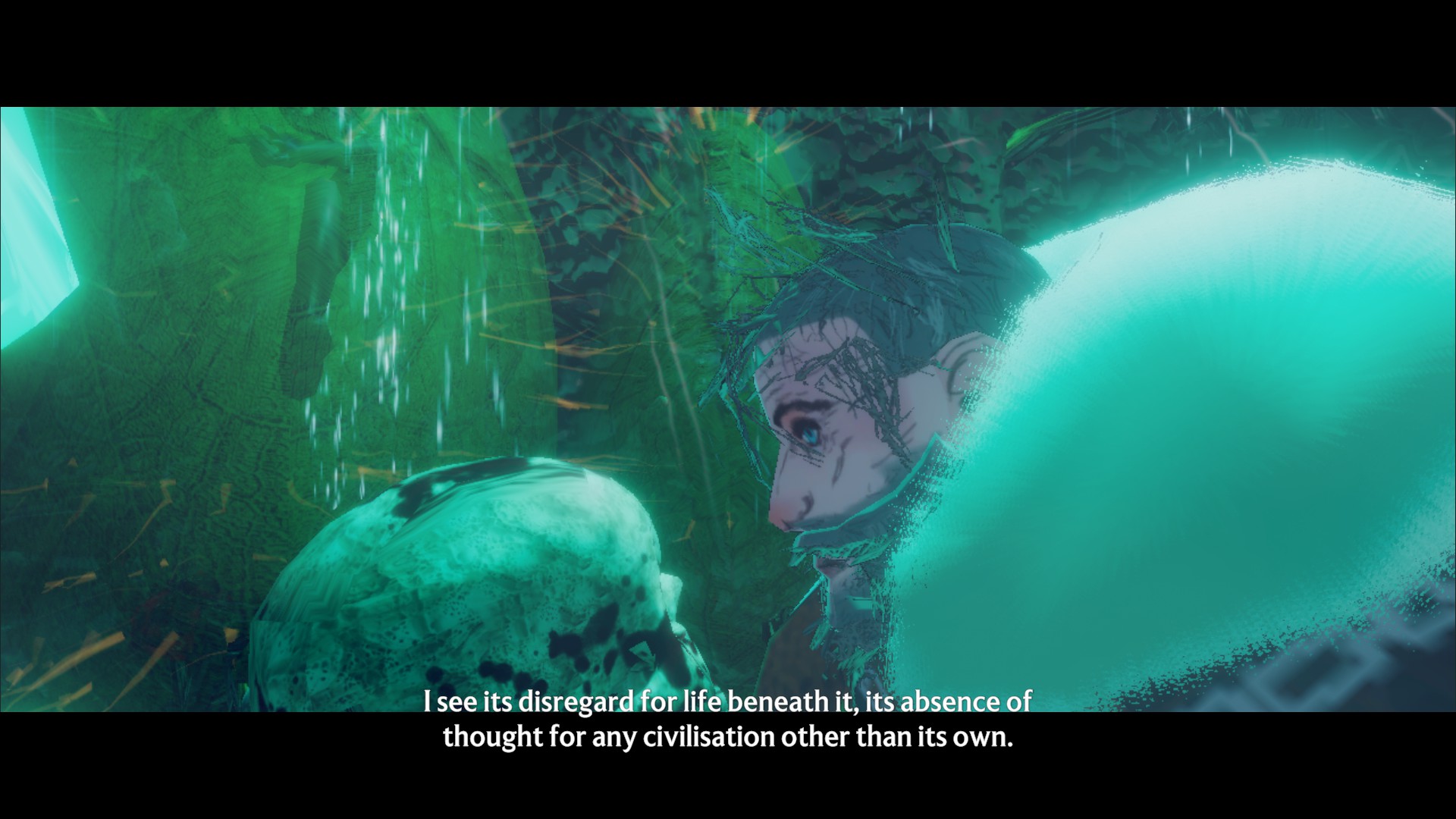
I think the idea to have the player experience this story from the eyes of one of the only true natives to the Antarctic, a penguin, is not only brilliant but extremely poignant. While the negative impact of colonialism on natives is spoken about with relative frequency in more progressive spaces, the perspective of the animal in the same situation is not often considered. Hell, the American Bison was almost hunted to extinction in the 19th century, despite being a species over 5,000 years old, and their story is not an uncommon one.
There’s a moment where the group of natives and the penguin stand next to one another after a particularly intense moment. There’s obvious passion from the natives, it’s not only seen through their actions but heard in their words spoken throughout the game. However, there’s another member exuding passion in that scene: the penguin. In that moment the rage, the fire that motivates the natives to protect their land is seen within the eyes of the penguin as well, I’m sure of it. It’s a breath-taking moment. While the connection between the penguin and the natives, particularly one within their ranks, is implied throughout the game this is the first moment we see their solidarity depicted with such intention.
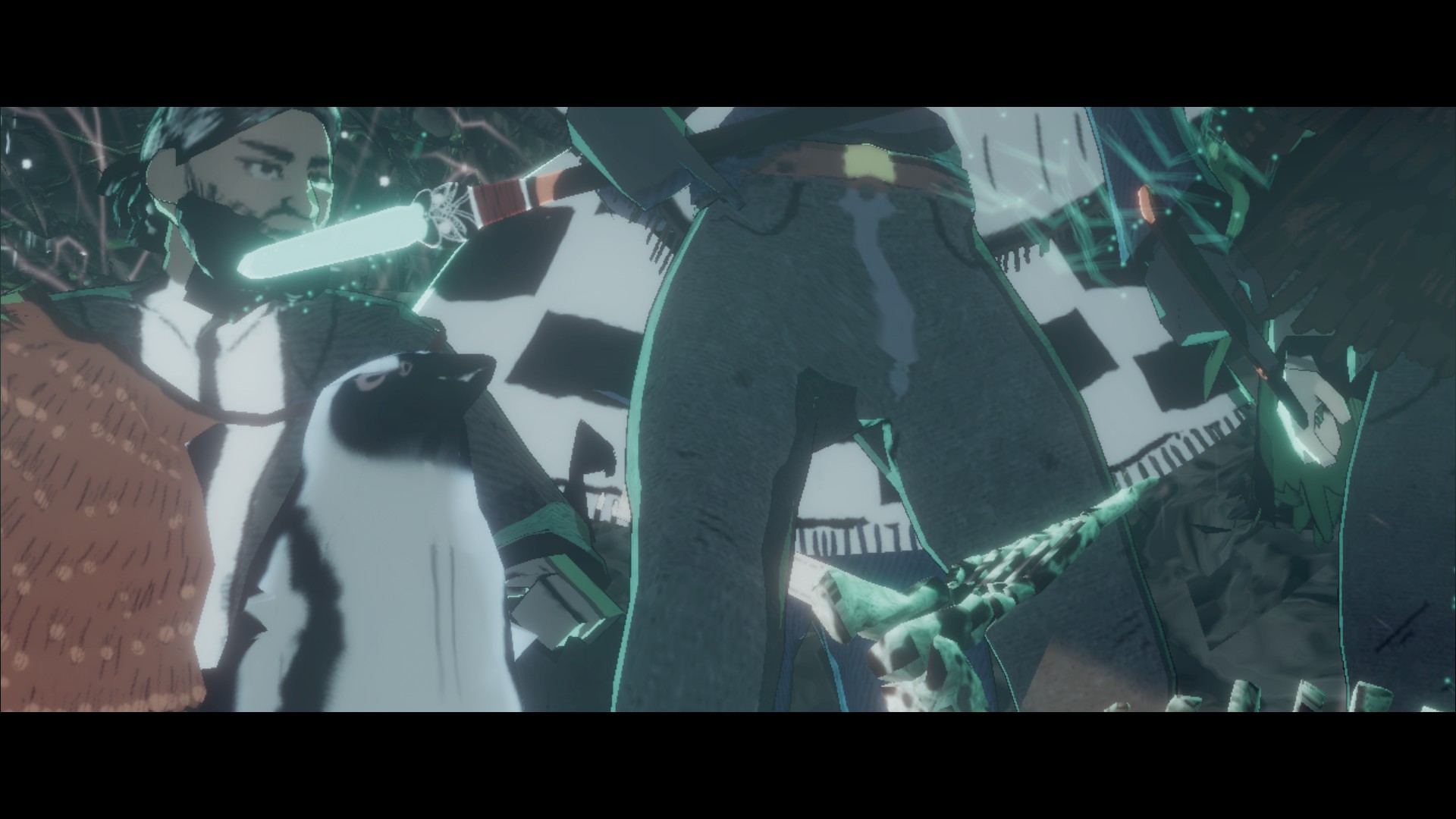
"Who will next find themself drawn to his voice - mesmerised by the promise of wealth and land? And who will take up arms to stop them?"
It was this moment that I knew Penguin Colony was a must-play. Despite floaty and sometimes janky gameplay, despite grievances with some map design, despite my desire for more in some places, I really do think Penguin Colony is a game every gamer that gives a damn should experience. It’s emotional, impactful, and thought-provoking in ways I didn’t expect it to be.
Moreover, the sense of exploration is genuinely phenomenal, allowing you to travel in seemingly any direction for quite some time. I found myself able to explore, discover, get lost, and then easily reorient myself toward my goal over and over, which was extremely satisfying. There’s even a collectibles map you unlock at the end of your playthrough to show you where you’ve been so you can share it with others and compare results, which I adore and I think every single game with collectibles should have.
There’s a distinct love for people, animals, and the Earth we live on shown throughout this game and, when the story it’s inspired by was written by such a resounding dick-head, I find that to be really neat.
Check out Penguin Colony, now on Steam.
Free Palestine. 🍉
**Disclosure: A key was provided for this review**