I don’t get the intense ping of nostalgia that people talk about with such frequency very often, but when I do I get hit with it real hard. It’s funny, then, that I’ve been bit by said Nostalgia Bug twice recently. Even funnier is that both pieces of media are video games.
Last week I wrote my review for Endacopia, a 2D point-and-click edutainment game where you play as a young boy on grand, and sometimes horrifying, adventures. I wrote about how deeply Endacopia resonated with a younger Me through its edutainment point-and-click gameplay, but also resonated with a more mature Me through its themes of abuse, escapism, and retribution. In my review I said that the era of CD-Rom child-like point-and-click games hit me much harder than most nostalgia because those were some of the first video games I ever played.
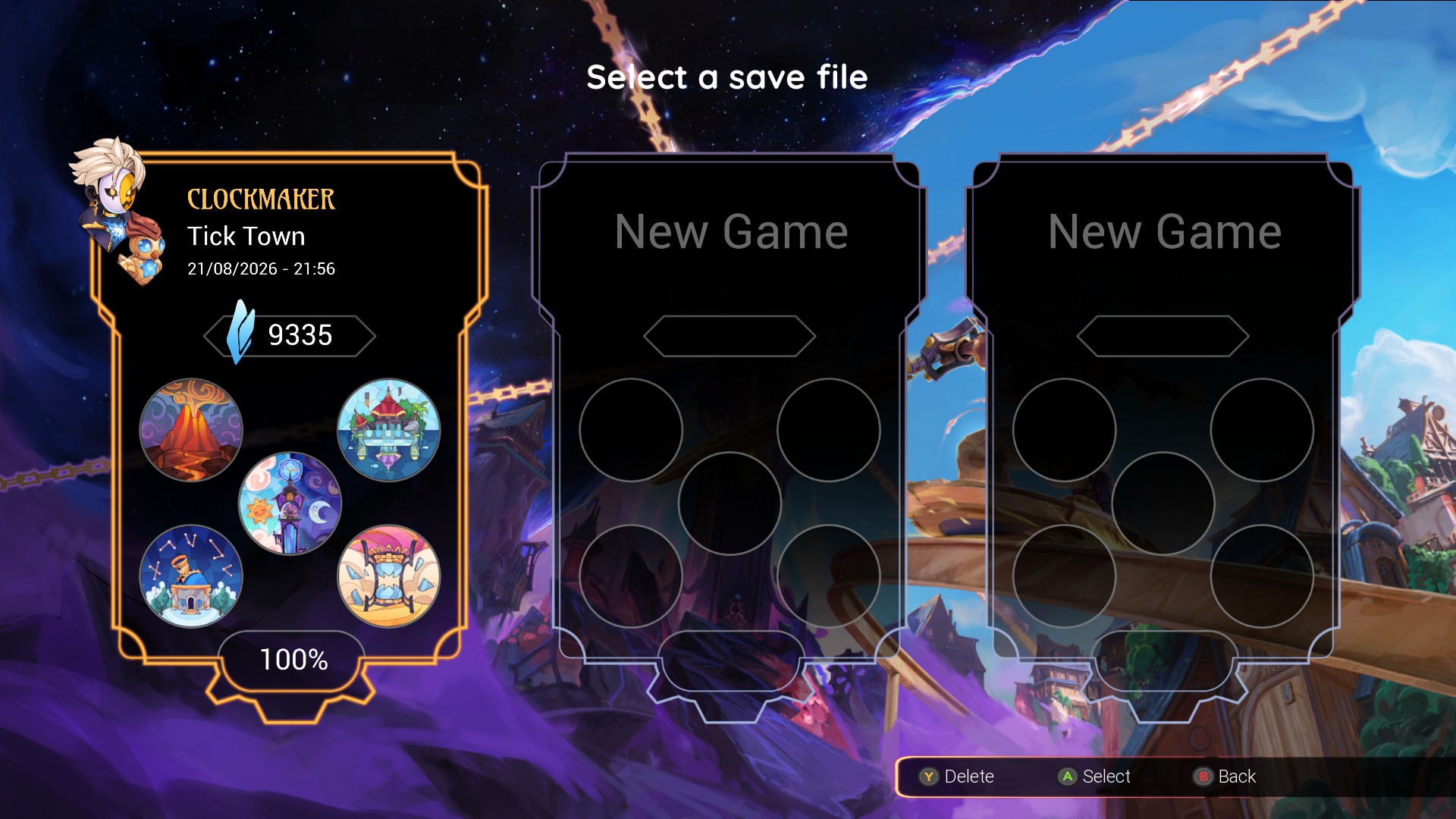
Then, right off the tail end of my Endacopia playthrough, Duskfade hits the scene. I had tried the demo for Duskfade back in June during Steam’s Next Fest and was stunned at the quality, so I already knew this was a day one purchase. Picked it up the day of release, fired it up, and was so enamoured by the world that I immediately went on to not only 100% my save of the game, but also get every achievement for it on Steam. To say I loved this game would, I think, be a gentle understatement.
'So what is this game, Bri?'
Sorry, sorry; let me get to reviewing. Duskfade is a 3D action platformer heavily inspired by Playstation 2 platformers, most predominantly Kingdom Hearts; though there absolutely is inspiration to be seen across the board in Duskfade. This is not your average Mario 64 inspired platformer; Duskfade is floaty, it has gimmicky mechanics, weapon, health, and ‘mana’ (temporal energy) upgrades, healing flasks, and a lot of combat. None of this is to say anything negative about Duskfade, yet at least (we’ll get there), but just to explain to you, Reader, that Duskfade stands out from the standard modern indie platformer. Duskfade is, without a doubt in my mind, a cut above the rest.
At the start of the game we meet Zirian, our protagonist that we will be controlling for the duration of this experience. He walks through the town with spirit and joy. When he arrives home he finds a door closed tightly and a heart shut even tighter. His sister, Allira, is too busy working on “something for them” to take a break and come out to eat some of her favorite pastries her little brother brought her. As an argument begins to fester between the doorway, disaster strikes like the chime of a clock. Zirian suddenly finds his home in ruin, replaced by a massive tower with yet another tightly closed door, housing his sister inside. The only thing Zirian receives in return is his grandfather’s sword and a small discarded creation of Allira’s, a talking cuckoo clock bird aptly named Cuckoo. With four massive chains around the door to the tower, your goal becomes extremely clear: break the chains to open the door.
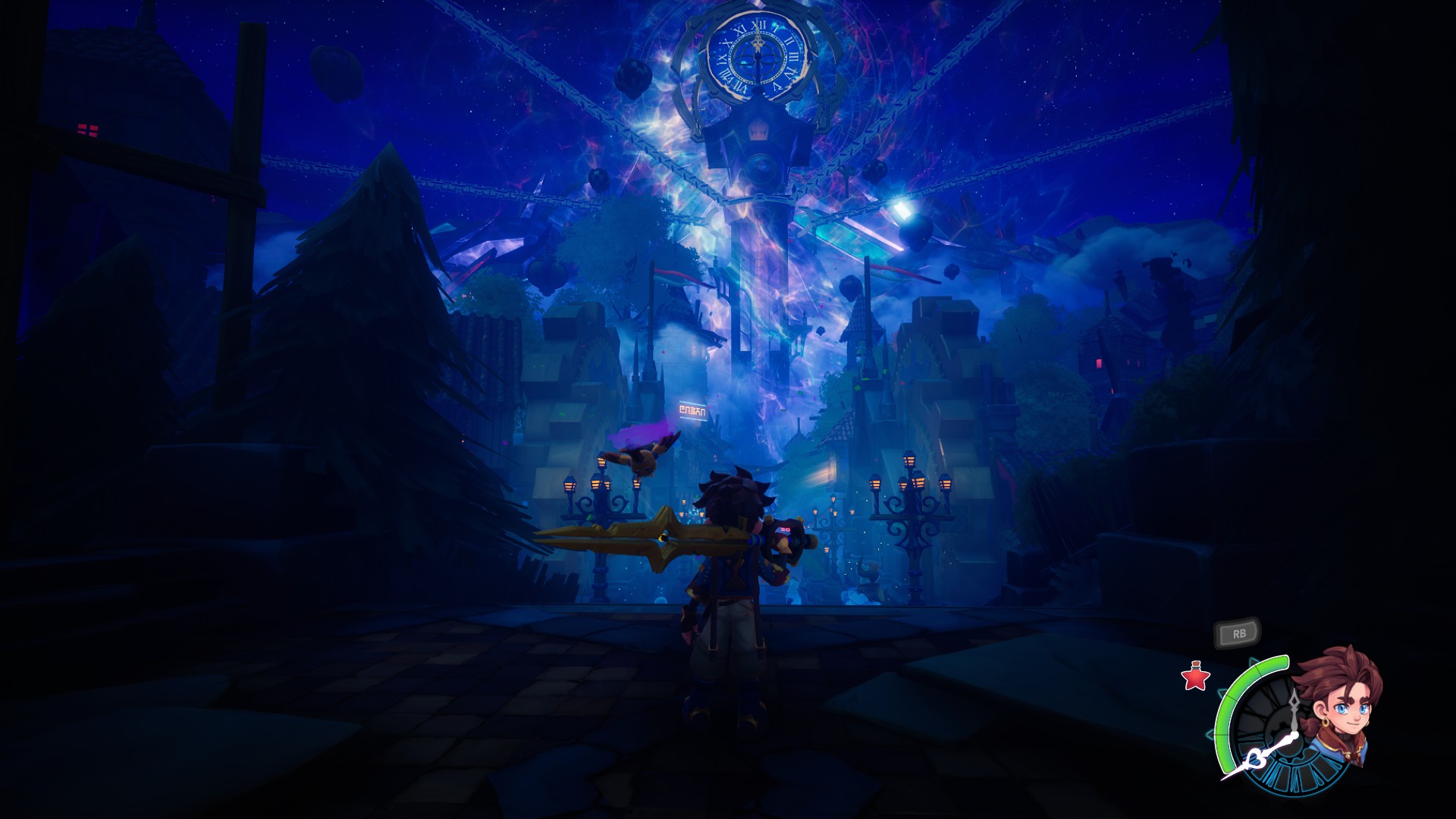
From here the story progression is relatively simple, you journey to the end of each chain collecting items, power ups, and lore along the way and defeating any enemies or bosses that stand in your path. Along your journey there are many platforming challenges, which you engage with in a multitude of ways as the game progresses. To start you simply have a jump, double jump, dash (or air dash), and a combo move that lets you jump further if you do a jump directly after a dash. As time goes on you will unlock upgrades like the grappling hook, sundial (skateboard for rails), and wings which will assist you in reaching harder to access locations on the map. Every area in the game is meant to be progressed through once for the story before getting an upgrade and retreading your steps to collect all the additional goodies later, if you so choose. This not only applies to your platforming abilities, but your combat abilities as well. Continuing through the game will also yield you upgrades like a stronger attack for your weapon, additional temporal abilities (magic), and more. Every upgrade assists you in traversing more of the map and unlocking more secrets. I found this particular gameplay loop to be wildly satisfying. As I stated earlier, I 100% completed my save, which involved collecting every single item on each of the 19 maps, including a secret item they don’t even put on the UI (for some reason). I had a lot of fun platforming around in this game and taking in the environments and music. The platforming is also really well done, which I feel can be especially difficult to do with floaty controls. Each of the paths were, generally speaking, quite fun to go through and the upgrades were, usually, equally fun to grab.
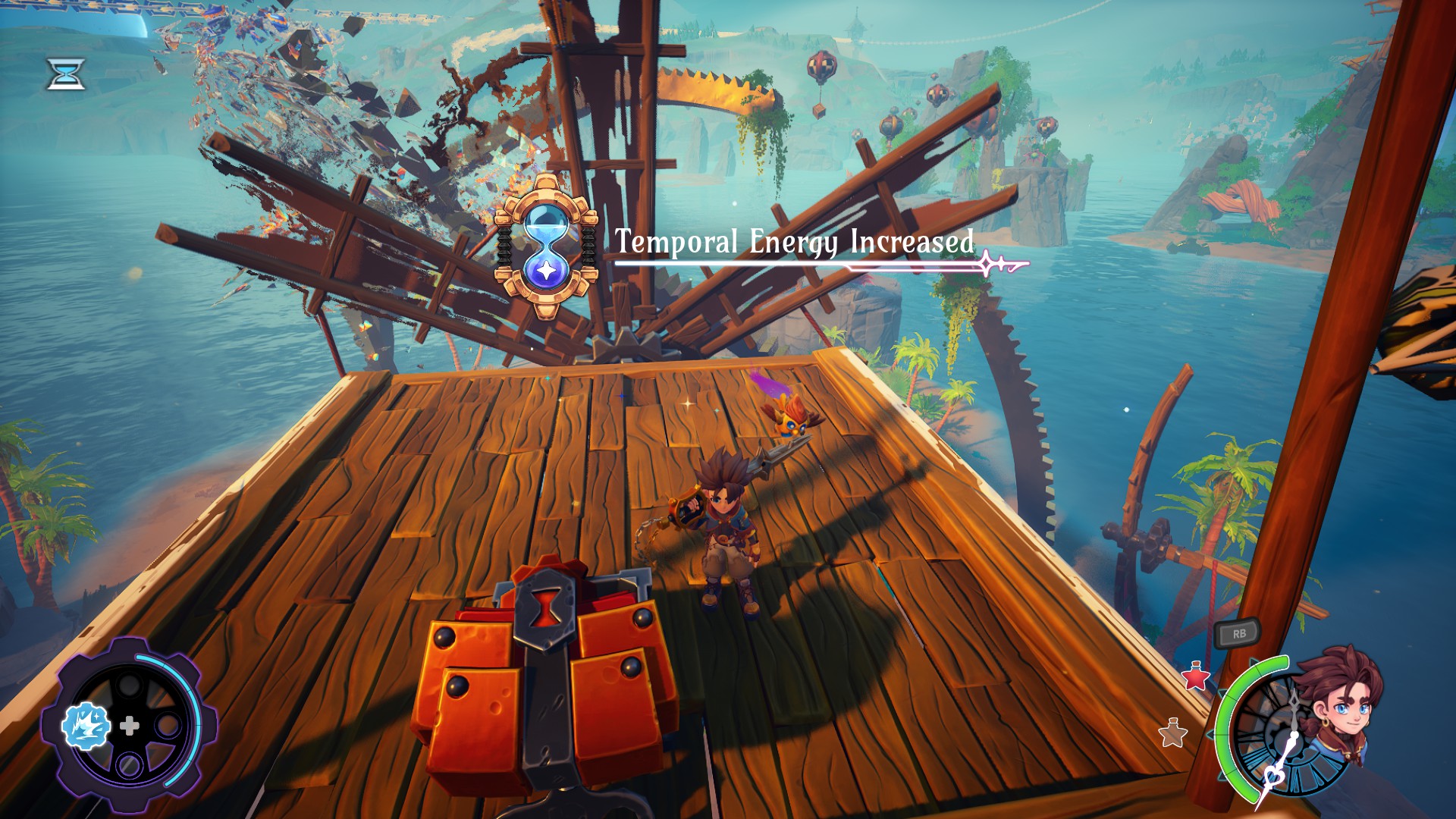
With that said, I did have some issues with platforming in this game. The sundial rail grinding segments often felt like I was fighting the controller rather than interfacing with it. Slightly janky controls aside, something I can generally deal with, these segments were also extremely fast paced and felt quite punishing; so when janky controls were added on top of those tense segments they more often than not left me feeling frustrated. This was really only an issue by the second to last area of the game, but said area was dominated by the rail segments including being central to the boss encounter of the location, so it was quite a headache. I also found the invisible platforms to be teetering on sadistic. There were a few moments, right at the very end of the game and for some of the more desirable collectibles, where you have to hit a bell to reveal invisible platforms. Hitting the bell only reveals them for a short period of time, at which point they are invisible again, save for some very hard to read particle effects. These segments made me an insane person, especially one where I had to do it to get a sword cosmetic, aka a rainbow ingot. These segments not only felt mean spirited, but also highly inaccessible. I was lucky enough to be able to get through them, but for vision impaired gamers I honestly don’t see how they will be able to make it through these segments. This is too bad too, because I feel this type of whimsical, floaty platformer should be accessible to everyone - not just the sweatiest gamers.
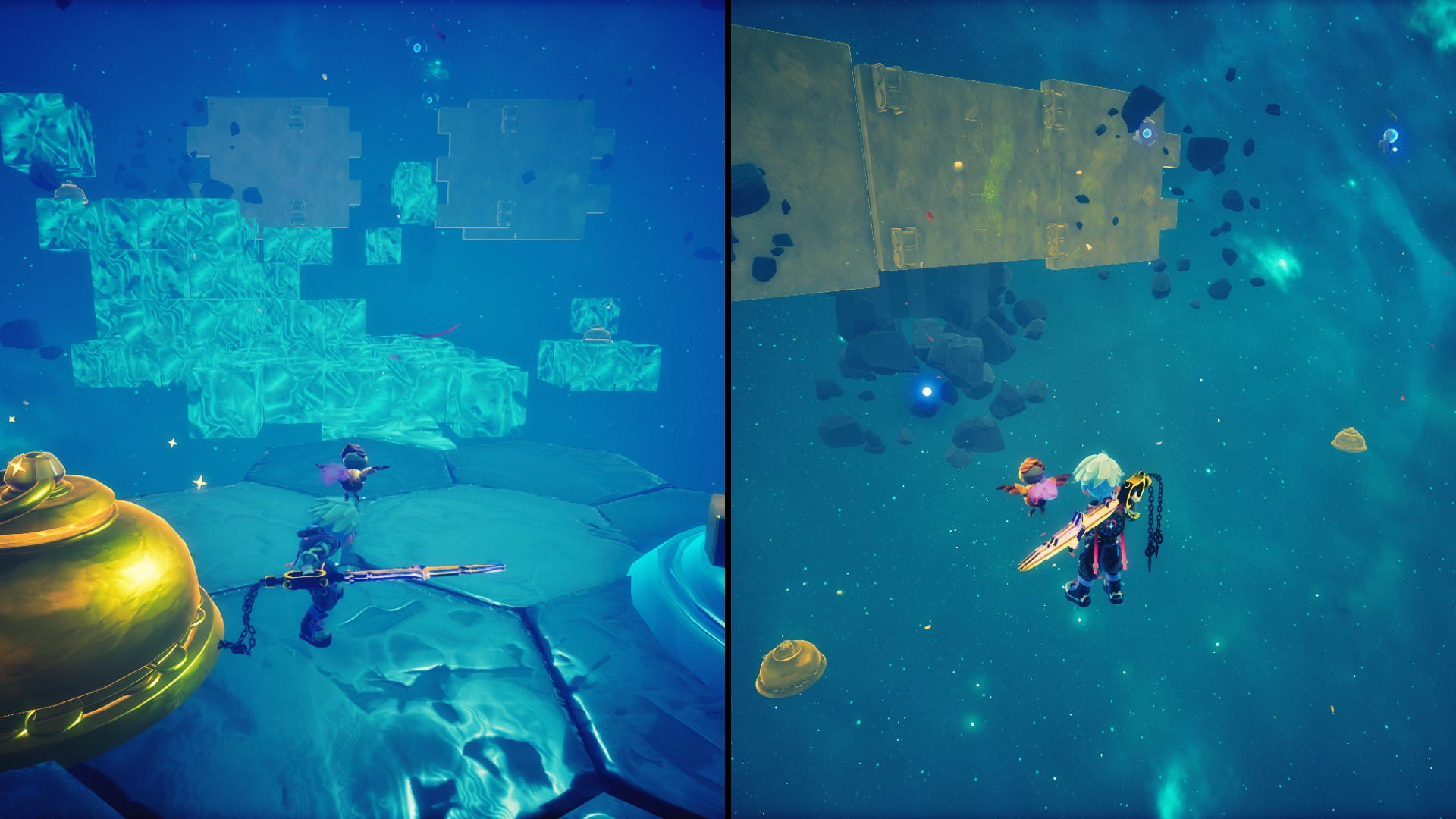
Pictured above: A platforming segment with invisible platforms. Ring the bell for temporary sight before having to navigate based on feeling (and barely visible particle effects) alone
I’ve read reviews of Duskfade myself, from the reviews on Steam to reviews by games journalists on a variety of websites, and one of the common critiques I’ve seen of the game is that the combat was not that great. I tend to disagree with this sentiment. While I don’t know that any of the combat was particularly deep when compared to things like Elden Ring or Hades, games that have literally thousands of combat combinations, for a 3D collectathon platformer I found the combat to be not only engaging but fun. There was consistent enemy variety, adding new enemies as you progressed through each area, eventually culminating in well over a dozen different enemy types, not including bosses. Each enemy had a different combat style, which would in turn change up the way you needed to approach combat with them. Upgrades like the different temporal abilities, weapon unlocks, and heavy attacks kept the combat feeling fresh throughout my entire 20+ hour playthrough.
That’s not even to mention the bosses, which I found most often to be a wonderful mixture of both combat and platforming. While much of this game is inspired by Kingdom Hearts, platforming and whimsy chief among them, the bosses felt hugely inspired by another iconic series, The Legend of Zelda. If you’ve never played a Zelda game, especially the more linear and “retro” entries, you may not know what I mean. This is all to say that, oftentimes, an area that housed a boss would also house an upgrade, like a stronger sword attack or the grappling hook. Once received the remainder of the area would challenge you to use that new ability as much as possible in an effort to train you for the boss battle ahead. A boss battle, mind you, that would require mastery of your newfound ability to beat. This combination of combat, platforming, and ability mastery made each boss not only feel unique but also continue to put up a substantial fight no matter how good you became at the basic combat. While the world and my ability to explore it was absolutely the highlight to my playthrough of Duskfade, the boss battles were an easy and close second.
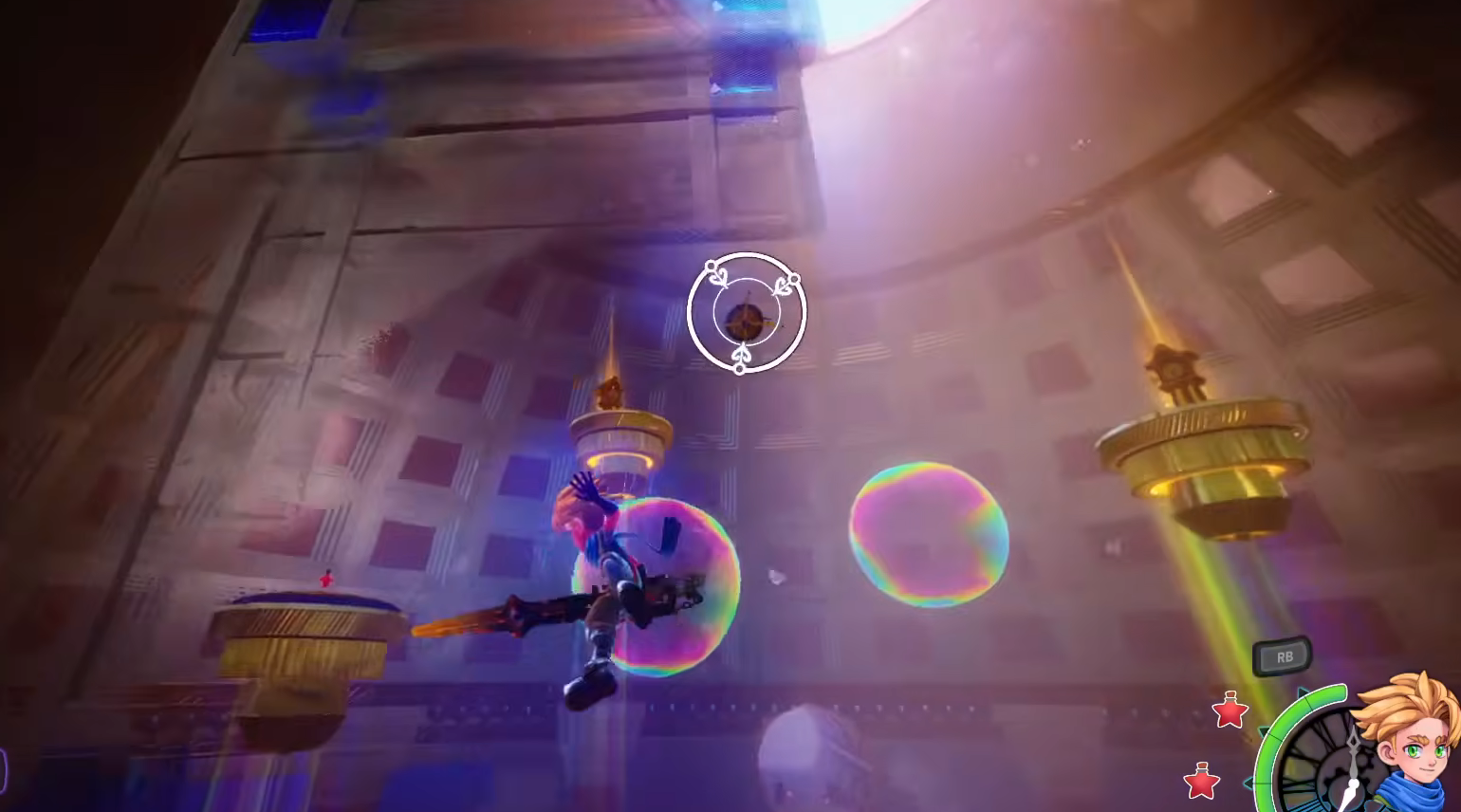
Pictured above: A platforming segment during a boss fight
To top it all off, I found the plot to be extremely heartwarming. I will say that it is written, at times, quite childishly but that was one of the main things giving it such an air of nostalgia; I wouldn’t want this changed, nor am I calling it a negative. With that said, this will come into play when I discuss the finale of this game. For the time being, however, I think the plot was wonderfully done.
You start your journey losing your sister, but gaining a new companion in the form of Cuckoo. She is direct and cold and, compared to Zirian’s warm and flighty personality, it’s hard to call her a friend. Despite that, Zirian welcomes her into his life with open arms, no matter the hardship he’s currently dealing with, calling her a friend before Cuckoo even wants him to. Throughout your adventure Cuckoo will whistle at you to indicate she wants to have a conversation nearby. These are usually back-and-forths in the form of reevaluating life; be it memories of old brought to the surface by visiting a particular location or memories of what the two have been through and how it will shape their relationship going forward. There are some pretty meaningful moments sprinkled throughout their conversations and it builds a deep relationship between the two over the course of the entire game.
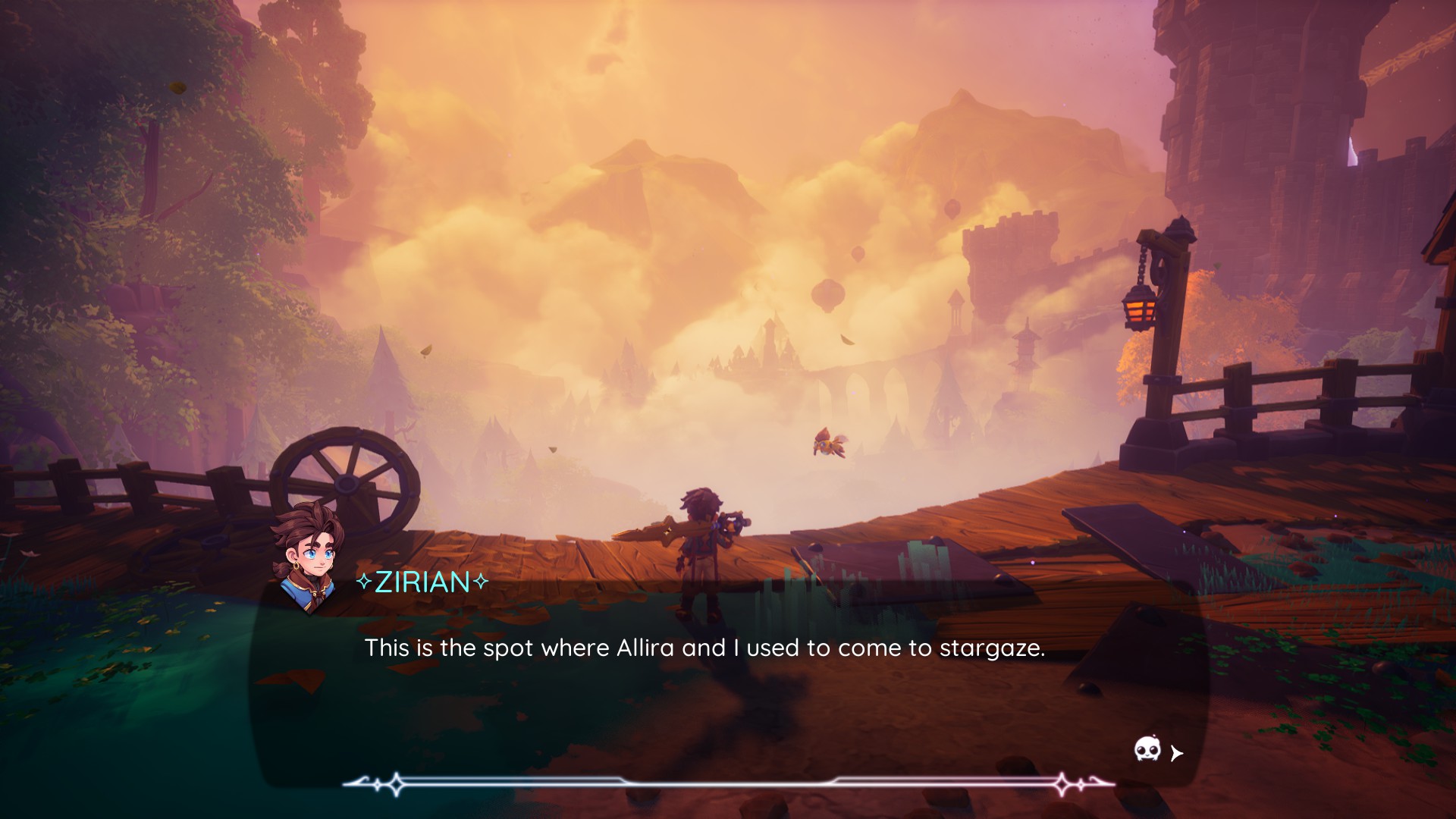
As you fight through each boss it becomes exceedingly clear that there’s a theme here, and that theme not only affected Allira, but is currently affecting Cuckoo. Many of the major bosses deal with feelings of grief, each giving us flashbacks to a time when Allira and Zirian’s grandfather and caretaker, Tristan, was alive but in declining health. We see not only how the deterioration and then eventual death of a loved one tore apart Allira and Zirian’s relationship, but also how it corrupted and changed Allira into a cold, distant person. A cold, distant person is what Cuckoo is to us at the start, but as we beat each boss, we grow closer and closer to her. She apologizes to us, worries about our well-being, and opens up to us as time goes on. In addition to Cuckoo, Zirian also grows throughout our journey. He starts out as someone that is unable to address negativity, unlike his sister who becomes inundated with it. As he travels with Cuckoo he is forced to face her negativity, forced to help her in the face of it and carry her through it. We, at one point, meet a man who has lost a loved one. Instead of being gently mournful for the man, Zirian is loudly optimistic, which is framed as insensitive.
Zirian learns to accept negativity, to be more gentle about it, and feel it himself. While Cuckoo learns to let negative feelings go and move forward instead of being stuck in past mistakes. They’re wonderful mirrors for not only each other and not only for the story we didn’t get to see, ie Allira and Zirian’s grandfather passing, but also for another story we nor Zirian were privy to; the Clockmakers' Tale. A tale of a people so stuck in the past and so frozen with fear that they attempted to freeze time along with them. A tale of guilt, despair, wrath, sadness, and solitude. A tale as old as Time. No one wants their time or their loved one’s time to end. No one wants to say “Goodbye”, but that isn’t our choice to make. “...Time [is] not a mechanism you can control, but a sigh which slips from between your lips.” A universal truth that must be learned generation after generation.
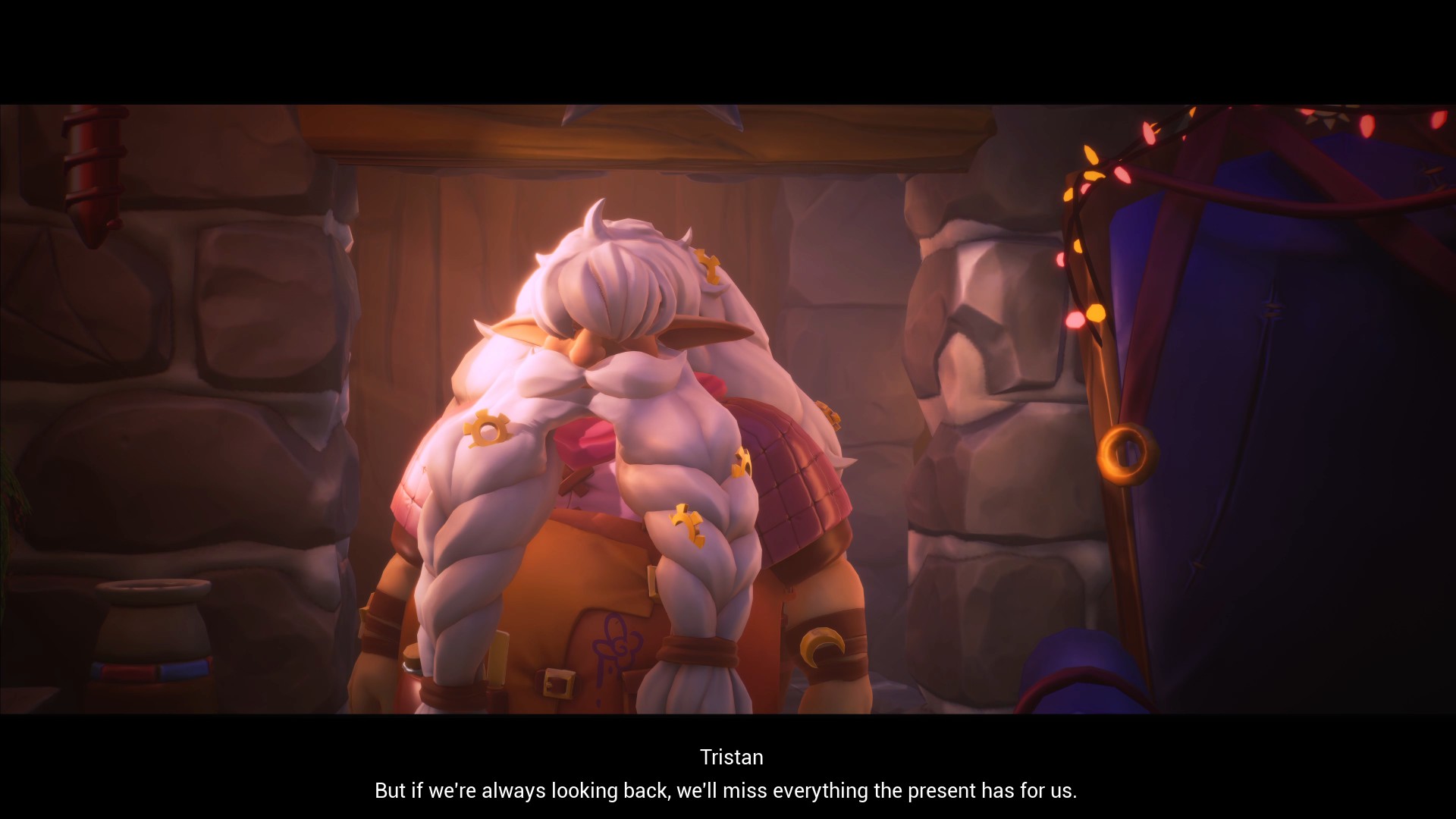
While the story, I feel, isn’t anything particularly elevated or groundbreaking, I did enjoy what was there. Like I said, the childish nature of some of the writing is a major factor in what made this game feel so nostalgic; as if the writing was for any demographic to pick up and understand completely. There were “twists” and “reveals” that I found to be abundantly obvious by the ending of the game, but with my understanding that this was an “all ages” story I was frankly fine with it. I don’t personally think every story needs to surprise you with a twist to be well told. With that said, I went through a lot of effort to get what I would call the “true ending” of Duskfade. This “true ending” was heavily alluded to by several characters before the end of the video game with sort of ‘do this before the final boss’ dialogue. So, as someone that adored this game and wanted the best for my two grieving siblings, I dedicated another day to searching for all the collectibles that would complete this branch of the story. I used a guide, something I don’t usually do, due to the fact that this particular collectible did not have a visual indicator of being collected in an area unless you 100%’ed said area (which is a major drawback, I might add). That’s fine, like I said I loved the platforming and was happy to keep playing. Hours of time and a cryptic essay later, I’d finally collected everything and I was ready to face the final boss. I beat the boss, got the ending cutscene, rolled credits, and then finally got my 'true ending' cutscene.
A cutscene that ended up being less than 60 seconds long, with three lines of dialogue that told me nothing new at all whatsoever. There was genuinely no payoff, other than seeing Allira and Zirian sitting next to one another. It truly, honestly ripped my heart out of my chest and stomped it on the ground. For context, I spent around seven hours collecting all these items for the “true ending”. Items, mind you, that I only collected because several NPCs heavily implied it would drastically change things! I found that to be, frankly, offensive. This game has a multitude of extremely high quality, fully voice acted cutscenes. I did not think I would be expecting too much when I assumed that spending another seven hours on collectibles would yield more than a 50 second cutscene with no lore.
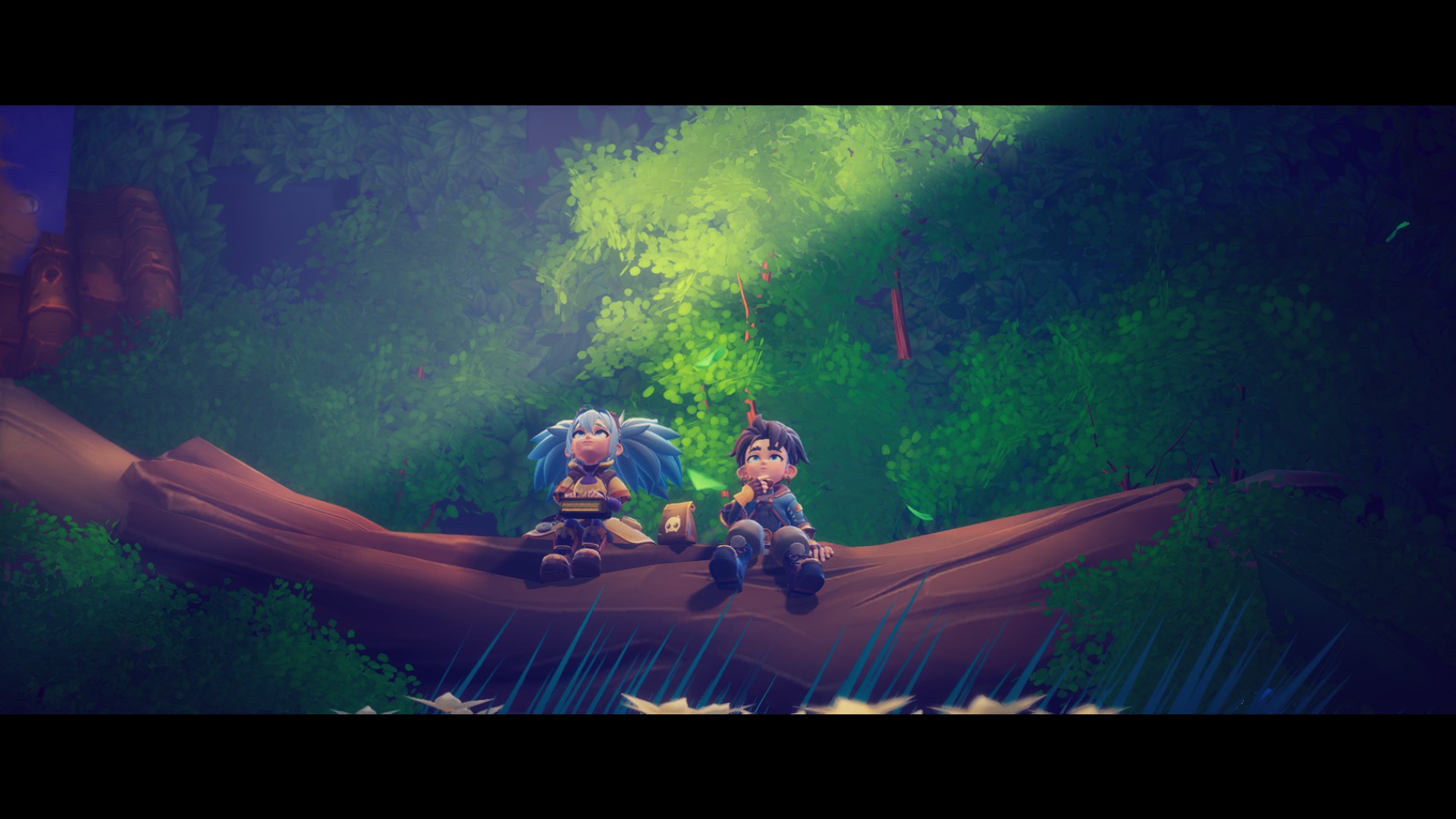
In addition to my complaint about the true ending, I really disliked that there was no post-game. After finishing my playthrough, despite my save saying 100% and yielding post-game content, I was put back in front of the tower before beating the final boss. I really did assume we would have the ability to walk around a more-or-less “fixed” town where our sister now happily resided and not having that was much more of a ding to my final judgement of the game than I had initially realized it would be.
While I’m also on the topic of issues with the finale, I found the final boss to be exceedingly underwhelming. Minor spoilers for the mechanics of the boss fight but there were literally no platforming gimmicks at all during the final fight. Sure, it was a fun enough fight, but for the final boss? After the developers already had me invested in these mechanically tight fights in addition to frantic platforming that made use of newfound powers? I truly expected a boss fight that pushed me to my limits, forcing me to make use of every mechanic at my disposal, to show a mastery of all the things I had learned throughout my time with Duskfade. However, that wasn’t the case. A fun enough boss to dodge and hit, but that was it. First try. Done. Game over. The end. Sure, there was a challenging enough platforming segment post boss fight to cap off the finale, but I don’t think that meant they needed to split the platforming mechanics from the final boss fight and I really wish they didn’t.
My feelings of lackluster with the ending don’t extend to the entire game. I played this game for around 25 hours and I loved so much of my time with it. The environments are absolutely stunning, full stop. Platforming is fun, yes, but part of that fun are these gorgeous maps you get to explore, discover, and take in. The animations on everything, be it the environment, NPCs, the player character, or in-game cutscenes are some of the most polished animations I’ve ever seen in a game, not to mention an indie game. Though, with that said, there are some issues with the cutscenes rendering and executing audio at the same time. Multiple times throughout my playthrough I would experience a cutscene where the audio was not synced up to the animations, which was a true tragedy as I said the animations are stunning and the voice work is extremely well done. Issue aside, the visuals in this game were a complete treat and I was only so disappointed by the audio desyncing because it is truly such a gorgeous and polished experience at every other turn.
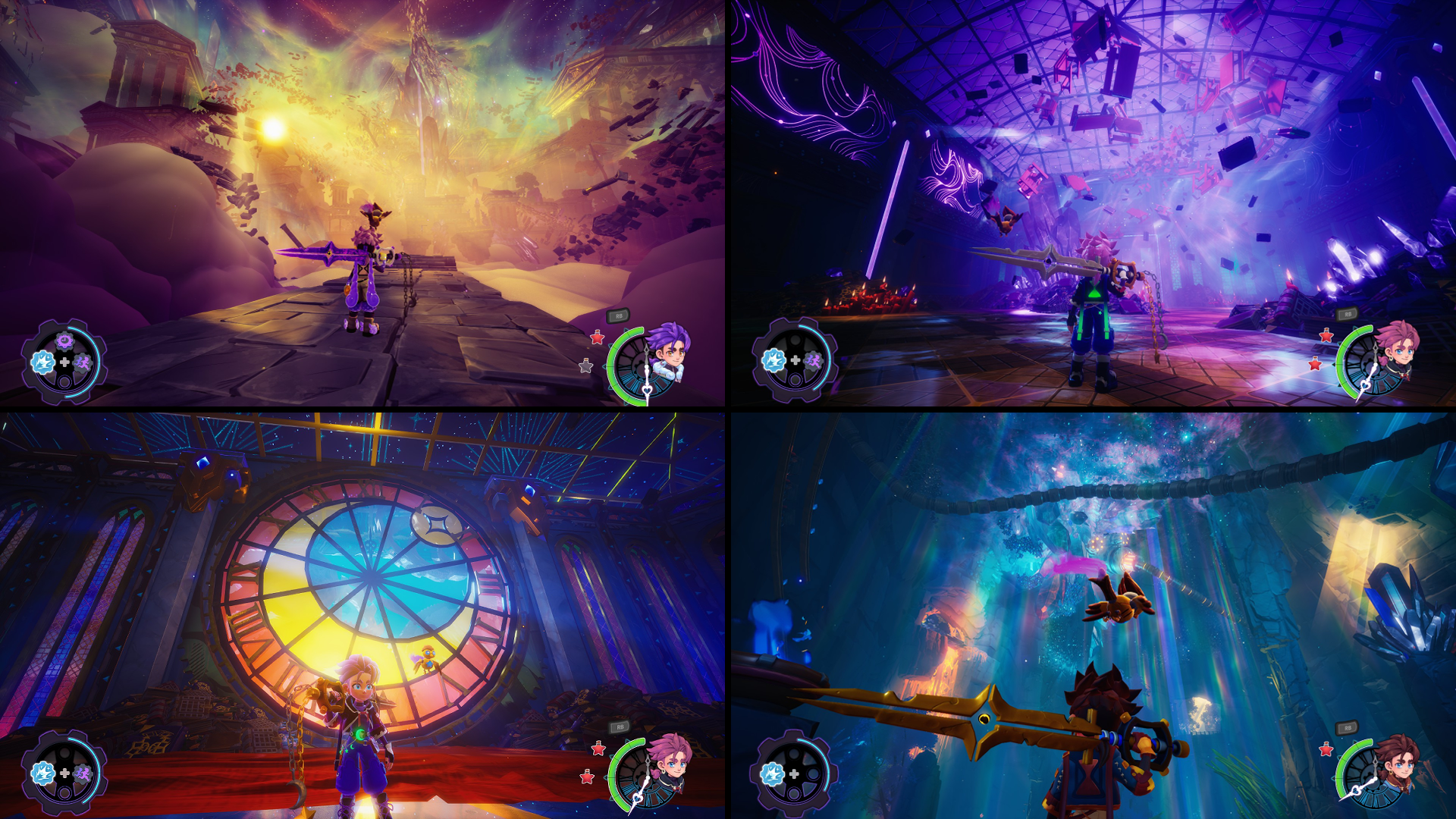
Duskfade's environmental design is matched by none, sparing no expense and even throwing in the kitchen sink
Speaking of animations, there are a lot of them, more than you may even realize at a first glance. Not only are there unique animations for each item you pick up, but there are also unique variants for a spoiler part of the game I won’t go into and as a visual indication of Cuckoo and Zirian growing closer. An example of this; every time you pick up the coin collectible in game Zirian tosses it in the air before catching it and accidentally hitting Cuckoo with his sword. By the end of the game when you pick up a coin you will sometimes see an animation where Cuckoo avoids getting hit by the sword, showing the player how the two are growing closer and more used to one another, warts and all. It's attention to detail like this that extends its reach throughout the entire game and all it's mechanics, making for a highly polished and immersive experience.
There’s so much more I could say about Duskfade, but I feel I would be going into rambling territory. I fear I may have already done so. There’s just truly so much to love about this game and what it does right. Does it do everything right? Absolutely not. By the end of the game I was definitely seeing and feeling a lot of the seams and rough edges more than I had in any other moment playing the game. Be that as it may, once all was said and done and I was recalling my time with the game I was remembering the good rather than the bad; making me just like the characters in the story. Did I want more from it? Did I want the whole experience to be perfect? Did I want more cutscenes and more lore and more and more and more? Absolutely, but so did the Master Clockmakers, and look where that got them.
At the end of the day, I wouldn’t have taken the time to 100% Duskfade if I didn’t like it. My anger at certain moments is simply an echo of just how much I loved this game; just as was Allira’s anger at her grandfather’s passing.
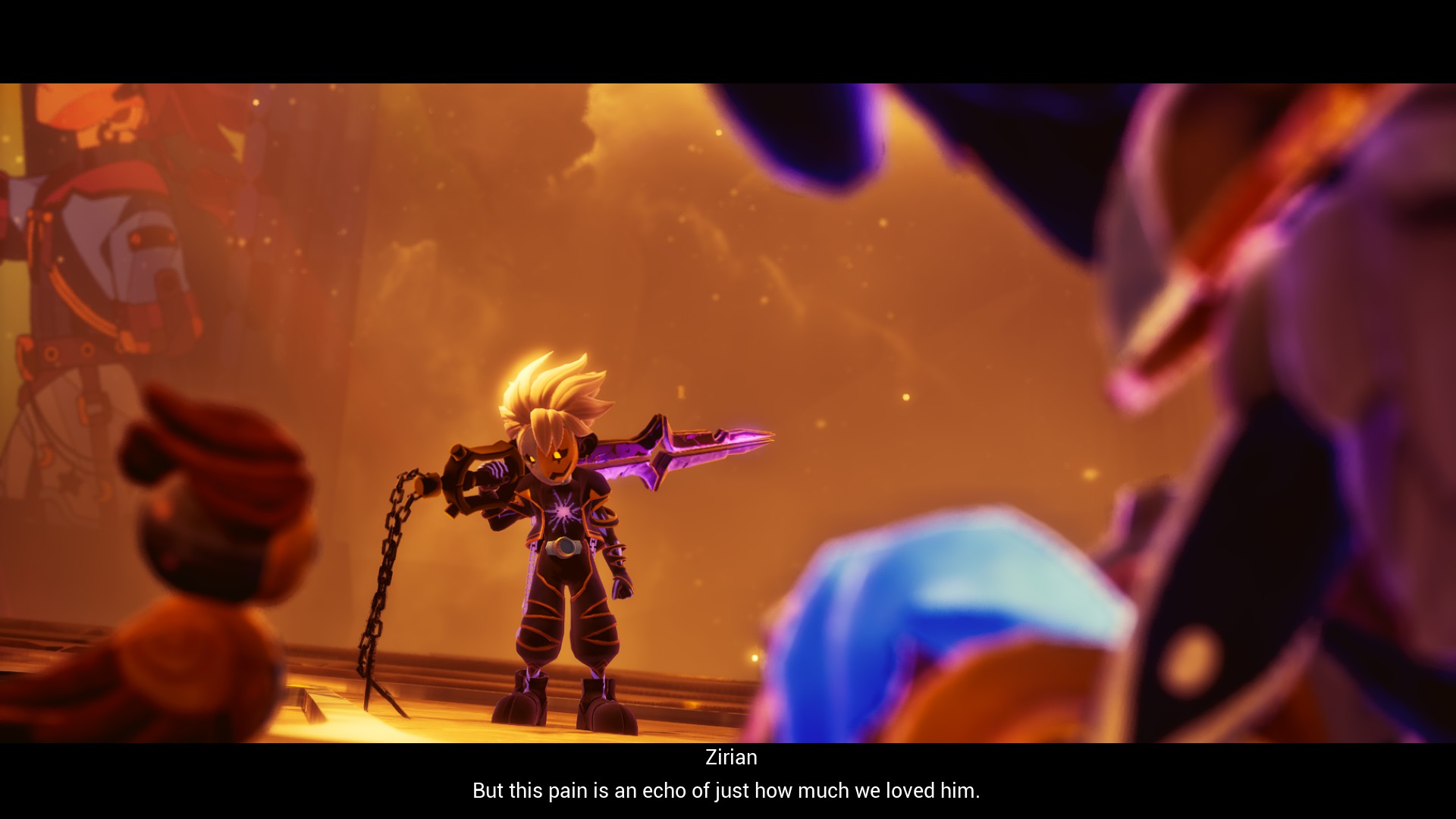
Check out Duskfade and enjoy your time with it while it lasts. I sure did.